🪴 Your "Messy" Background Is Your Edge
[FREE] Your non-traditional path is your hidden advantage
First deep dive of 2026, yay!
The last couple of months have been... let's say chaotic. Wait — chaotic? I don’t mean disordered and confusing.
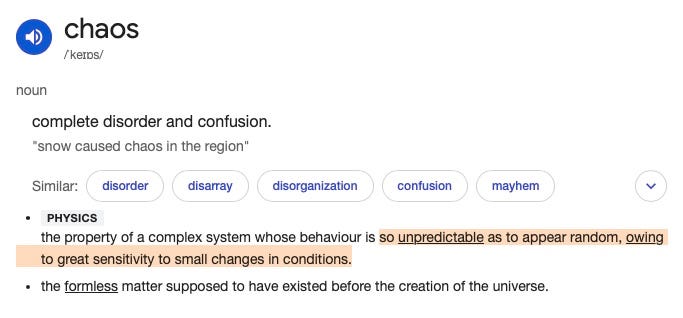
The latter definition seems closer to what I’ve been trying to say. The property of a system whose behaviour is so unpredictable, as to appear random.
Emphasis on random. That’s the word.
I'll use chaos interchangeably with randomness, timing, luck, and other hidden constraints. Because that's the problem that made me write this dive.
What would my day today look like if I'd made one less misstep last year? Would anything change? Would the butterfly effect screw me over?
People keep assuming outcomes come from variety of shaping factors: skill, planning, intelligence, grit. This leaves this often overlooked variable: chaos.
It affects absolutely everything.
Where you were born. How your brain functions. What personalities your closest people had growing up. What your early ambitions became and how you chose to execute them.
If you took two random people on earth and expected them to have identical values across all these metrics, you'd have a higher chance of picking two grains of sand from the planet and having them be from the same rock.
However, some people experience more chaos in their life, than others.
Does this make them perform better, or worse overall?
Turn RAG into riches with Delve’s AI for security questionnaires
Hate those endless security questionnaires? We do too. So we hired the sharpest AI brains from Stanford, MIT, and beyond—and made them do your grunt work. Delve uses state-of-the-art agentic RAG, not your average “retrieve + answer” hack.
Our agents think ahead: pull evidence, resolve conflicts, reason across your policy graph, interrogate your infrastructure, and draft bullet-proof responses.We’re helped Lovable, Bland, Micro1 and a ton of the fastest-growing AI companies navigate and close review with almost every F50 - and saved dozens of hours with our AI-native compliance platform.
Book a demo with Delve and get $1,000 off SOC 2, HIPAA, GDPR and more - and automate security questionnaires away forever.
Use FOUNDERSFUEL1KOFF for $1K off.
TL;DR
Startups and investors overvalue smooth resumes (stable upbringing, elite schools, FAANG) as performance predictors in chaotic environments.
Hidden Talents framework + executive function research shows stable environments build inhibition (focus, rule-following), while harsh/unpredictable ones build shifting (rapid updating, task-switching, uncertainty navigation).
Startups live in shifting world: messy information, moving markets, investors changing minds, no syllabus.
Chaotic backgrounds can hide real advantages for these conditions — not just scars.
Too much chaos breaks you (PTSD, burnout); too little chaos makes you fragile outside known rules. The target is being the anti-fragile founder who turns past chaos into strategy instead of being run by it.
Part 1: Smooth Water Fallacy
There is a dangerous misconception in the startup world that the best people come from the smoothest backgrounds.
We search for signals of stability in people. Settled home. Good schools. Liked at school. Sports teams and leadership positions. Our brains default to safe bet when life has looked orderly on paper.
With founders, the pattern repeats. Stanford. Strong GPA. FAANG internships. A neat story of performance inside highly structured systems. The assumption is that if someone excelled in predictable environments, they will also excel in the wild.
Let’s call this a smooth water fallacy *trademark pending*.
The Hidden Talents framework (Ellis, Frankenhuis, et al.) shows how childhood environments shape cognition:
Growing up in harsh or unpredictable environments does not only create “damage”; in some contexts, it can build strengths that standard metrics miss.
Their work looks at how different childhood environments shape cognitive skills.
Stable, predictable settings tend to reward and reinforce inhibition: the ability to tune out distractions and follow a clear plan.
Inhibition is what you see in someone who can sit with one hard problem, ignore everything else, and move step by step through a syllabus, a promotion ladder, or an optimisation problem. It is the skill set that wins in environments where the rules are known and change slowly.
Growing up in more chaotic or unpredictable settings often forces people to practice shifting: rapidly updating, scanning for new information, and switching between competing demands. Some studies find that, in tasks that resemble these conditions, people from harsher environments can perform as well as or better than those from very stable ones.
Shifting is what you see in someone who can move between (figurative) fires without freezing, re-route when the path changes, and keep track of multiple moving elements at once. It is the skill set that helps when the rules are unclear and the situation keeps flipping on its head.
Although in reality, these skills sit in the same executive system and overlap – you do not get one for free without trade-offs. I’m a firm believer every human has a total score of 100 across everything, and if you are gifted in one are you are disadvantaged in others.
This is where the founder angle comes in. Most startup environments look a lot more like the second world than the first. Messy information, incomplete data, shifting markets, investors changing their minds, and teams that are still forming.
If you drop a founder who is heavily trained for inhibition into that environment, they can struggle. They go looking for the rulebook. They want the path laid out. They try to turn uncertainty into a neat checklist, and when that fails, they stall.
Drop a founder who is comfortable with shifting into the same chaos, and something different often happens. They scan. They experiment. They make sense of noisy signals faster because they are used to reading situations that don’t come with instructions. It is not that they enjoy chaos, but that they are less shocked by it.
None of this means chaos is better. Adversity comes with real costs, and the research is clear that harsh environments can impair as well as sharpen, depending on the domain and the task. But it does mean the story “stable equals stronger founder material” is too simple.
However, if you grew up thinking your chaotic background left you with baggage, it may be worth updating the story. You may not have the smooth-water badges, but you have something else: a different operating system that can be extremely valuable in environments where certainty is rare and plans break on contact with reality.
Part 2: Chaos as Information Density
Part 1 showed what chaos trains. This shows how it works.
In a smooth, ordered life, the information comes in neat, low‑variance chunks. Every input is the same size, the facts are static, the lessons are predictable. That’s the world most of our selection systems are built around.
A chaotic life is a high‑variance information source. You don’t just move through it; you have to constantly sample it. What looks like baggage from the outside is, in reality, a huge amount of data your brain was forced to process early and often.
In that kind of environment, you walk into a room and immediately scan it. Track tone, posture, timing, becoming hyper‑vigilant. That can be a liability in a calm, rule‑based corporate environment where the safest move is to keep your head down and follow process. But in a startup, where the real risk is missing weak signals, that same hyper‑vigilance can be an asset.
Chaos‑trained founders are used to integrating conflicting cues, updating quickly, and acting before the full picture is clear. They can read micro‑shifts in mood, customer behaviour, or market sentiment and feel the crash coming a few frames earlier than everyone else, because that is how they learned to stay safe.
In a corporate job, your goal is often to avoid the burning building.
In a startup, your job is to run inside, contain the fire, and rebuild while it is still hot.
Your chaotic upbringing trained you to operate inside noise rather than waiting for calm. Those outcomes reflect an earned information advantage — one the startup world systematically underrates by overvaluing smooth backgrounds while science shows chaotic ones build real strengths for high-uncertainty environments.
Part 3: The Goldilocks Zone
Not all chaos works.
Too much chaos breaks you: PTSD, focus issues, burnout. Real costs, not hidden superpowers.
Too little chaos creates fragility: optimised for known rules, you crack when scripts fail.
Chaos doesn't make you better overall. It strengthens uncertainty skills, weakens sustained focus. Startups reward the first set.
Your target should be becoming the anti-fragile founder: someone who has taken chaotic experience and turned it into strategy without letting it run their life. They don’t chase entropy for its own sake, but they assume it will show up.
Successful founders are not the ones who seek chaos; they are the ones who can process it. You do not want an addiction to starting fires. You want the ability to move through a storm without losing the plot.
Part 4: The Controlled Chaos Protocol (The Solution)
So what if your life has been mostly ordered so far?
What if you recognise yourself as a high‑inhibition type: great in structured systems, underexposed to real volatility?
It means your shifting muscles are undertrained and your data set is too clean. The fix is to inject controlled chaos into how you work.
Your job as a leader is to manage chaos. Your job as a student of the game is to experience enough of it that your brain can switch between inhibition and shifting on command. You need environments where the stakes are real, but not company‑killing.
So this week:
Pick a harder market. Target F500 instead of SMBs. Pitch your competitor's best customer.
Shorten your deadlines. Cut feature launch from 2 weeks to 7 days. Improvise.
Real uncertainty. Ship weird feature, test unproven channel, run pricing experiment you’re unsure about.
This is not sabotage. It is deliberate training.
The goal is to move yourself along the curve; from only operating in smooth water, to being able to think clearly when something happens to be out of order.
Smooth founders: build your chaos muscle. Find chaos and work with it.
Chaotic founders: refine your edge, don't apologise for it.
Stop controlling every variable. Add just enough entropy to adapt, not crack.
Hope you liked this 💎 [FREE] deep dive 💎
Paid tier drops next week: 1 free deep dive/month, rest paywalled.
Running a pre-sale now: 22% off FOREVER (just 1 kebab/month)
How I can help
👨💻 Software
Need a top tech talent for your next product? Are you looking for your next gig? I’ve got you sorted.
📢 Advertising
Advertise in my newsletter to get in front of 11,120 founders.
🤿 Get more deep dives
Upgrade to a premium subscription to get an extra deep dive a week.


